

Blog

It’s 2026… Do You Know If You’re in Compliance with Washington, DC’s Building Energy Performance Standards (BEPS)?  

It’s the first evaluation year for DC BEPS. Buildings 50,000 square feet or larger must prove that their energy efficiency measures have improved building performance. Stringency is expected to increase for all covered buildings when another BEPS cycle begins in 2028.

Aerial view of downtown Washington, DC showing multi‑story office buildings along Pennsylvania Avenue under a clear blue sky.

It might feel like yesterday when Washington, DC announced its Building Energy Performance Standards (BEPS) compliance rules. That was 2021, and as of January 1, 2026, the District officially entered the BEPS Cycle 1 evaluation year.

For many building owners, this is the moment when benchmarking shifts from a reporting exercise to the real compliance test.

The First DC BEPS Evaluation Year

This year looks different for covered buildings depending on size:

Buildings 50,000 SF and Above – It’s Showtime

For buildings 50,000 square feet or larger, 2026 marks the formal evaluation of BEPS Cycle 1 performance. Buildings that fell below the median energy benchmark for their typology will be assessed on whether they successfully demonstrated improvement during the five-year compliance cycle.

This is the point where performance outcomes matter, documentation matters, and enforcement becomes real. DOEE’s BEPS helpdesk outlines enforcement and penalties for non-compliance.

Buildings 25,000 – 49,999 SF – Keep Benchmarking

Buildings between 25,000 and 49,999 square feet are not yet subject to performance targets, but owners must continue annual benchmarking. Don’t forget to submit 2025 energy data by May 1, 2026.

Tip: Consider third-party verification of your 2025 data. More on this below!

Buildings 10,000 – 24,999 SF – Start Benchmarking

Benchmarking is now mandatory for privately-owned buildings 10,000 square feet and above. Calendar year 2025 energy data must be submitted to DOEE through ENERGY STAR Portfolio by May 1, 2026.

What To Do About BEPS

Median energy benchmarks will continue to shift. Whether you’ve met BEPS requirements or are struggling to keep up, there are key actions to take this year.

Even buildings that currently meet the BEPS for the current period should continue proactive planning, especially if major capital upgrades are expected before the next compliance cycle.

These are the questions to address if you’re an owner of buildings currently covered by BEPS.

Is Your Benchmarking Data Actually Accurate?

Accurate benchmarking data is the foundation of DC BEPS compliance. Before assuming anything about compliance, review your Portfolio Manager data carefully. Common mistakes include:

  • Incorrect gross floor area, number of stories, or other building attributes
  • Missing or misclassified space use types
  • Incomplete utility data feeds (compare other sources of information if available)
  • Meters that should be excluded (e.g., cell towers, EV charging equipment)

A good place to start is ENERGY STAR Portfolio Manager’s Data Quality Checker. If updates need to be made to your Portfolio Manager entry, we can work with you to ensure you have the documentation you need.

SWA also regularly supports building owners with third-party data verification. We’ve found that benchmarking data corrections are needed in up to 75% of the time for benchmarked but not verified buildings!

Previously required every three years, third-party verification for benchmarking data is now mandatory every six years. The next verification year is 2027 for calendar year 2026 data, then every six years thereafter. However, building owners can opt to do third-party data verification anytime.

Accurate data is critical for making informed decisions about short-term upgrades, capital planning, and long-term compliance. Verified data helps owners understand how buildings truly perform heading into BEPS Cycle 2 and beyond.

Do You Know Your Buildings’ BEPS Targets?

Meeting BEPS is about knowing your numbers: What is the site EUI that is likely to meet the BEPS for each building?

ENERGY STAR Portfolio Manager includes target-setting tools that allow you to model required site EUI levels corresponding to each building’s BEPS compliance pathway. This should be a standard step in any DC BEPS compliance strategy.

Are You Tracking Performance Throughout the Year (Or Just Once)?

Strong BEPS performers pay attention to energy use trends, not just year-end numbers.

Here’s what to focus on throughout the year:

  • Is my rolling EUI responding as expected to weather?
  • Are recent upgrades delivering the energy savings we projected?
  • Are major energy users like chillers, boilers, and dedicated outdoor air system (DOAS) units operating as intended?

Preventive maintenance and ongoing performance reviews can mean the difference between penalties and compliance.

What Projects Will Improve Energy Performance?

If your building needs updates, here’s how to identify potential projects that will impact energy performance:

Start with an energy audit. This helps identify high-impact efficiency measures, develop scopes of work, estimate costs and savings, and inform capital planning. Supporting materials such as drawings, O&M manuals, and direct digital control (DDC) trend data are critical to moving efficiently from audit to implementation.

Why DDC trend data? It’s hour‑by‑hour or more frequent, time‑stamped operational data that shows how building systems actually perform over time. It helps owners understand where energy is being wasted and where improvements will have the biggest impact.

Consider re-tuning or targeted retro-commissioning. If performance issues aren’t obvious, look into retro-commissioning. This can uncover hidden operational inefficiencies and low-cost savings opportunities in a cost-effective way.

The process involves inspecting, testing, and reviewing operational data for major energy-using systems to realize performance improvements and confirm what can be accomplished without significant outlays.

Are You Thinking About Electrification?

Building owners should begin aligning building upgrades with future performance targets and thinking about how to fully electrify building systems.

We expect future BEPS cycles and related policies to target greenhouse gas reductions, which lends itself to using more electric and less gas. A trajectory pathway is anticipated for Cycle 2 which will allow improvements against a longer-term energy use target.

How Can I Keep Up with BEPS Rule Changes?

2026 is a transition year, and expectations will increase for all covered buildings when BEPS Cycle 2 begins in 2028. Building owners should pay close attention to updated guidance from DOEE. Here are things to watch for:

  • Updated BEPS Compliance Guidebook coming soon (draft updates were released for public comment in December 2025)
  • A trajectory-based compliance pathway, which is likely a best fit for buildings expecting major system replacements in BEPS Cycle 2 or 3. A working group is developing a proposal for this approach.
  • Increased emphasis on documentation of energy efficiency measures considered and costs to comply

Way Off Track? You’re Not Out of Options

If compliance feels out of reach, don’t wait until penalties are looming. Resources available to DC building owners include:

There are a variety of ways to seek additional time to comply or propose alternate compliance approaches.

Need a Refresher?

Washington, DC’s Building Energy Performance Standards (BEPS)

How It Works

  • Covered buildings must submit energy benchmarking data annually to DOEE.
  • Private buildings 50,000 SF and larger must demonstrate energy performance above the median for their building type established at the beginning of their compliance cycle (this will expand to smaller buildings in future cycles).
  • Covered buildings that fall below their median have five years to demonstrate improvement through an approved compliance pathway.
  • BEPS targets are scheduled to be reset for cycles starting 2028 and 2034.

The Full Story

The Clean Energy DC Omnibus Amendment Act of 2018 established minimum Building Energy Performance Standards (BEPS) for existing buildings.

The law requires all private buildings over 50,000 SF to benchmark energy use and demonstrate energy performance above a median baseline beginning January 1, 2021. It also lowered the threshold for buildings that need to benchmark: buildings between 25,000 and 49,999 SF needed to benchmark energy use beginning in 2021, and those between 10,000 and 24,999 square feet needed to benchmark energy use beginning in 2024.

If a building does not score above the median ENERGY STAR score (or Source EUI for buildings that cannot receive an ENERGY STAR score) of Washington, DC buildings of their typology, it has five years to demonstrate improvement or face financial penalties.

By definition, 50% of the buildings required to comply with BEPS fell below the median, even those just a point or two under. (You can download a list of property types and their medians here.) Building owners can use this map from DOEE to check if their building meets the BEPS.

The BEPS requirements will be re-established every cycle, creating BEPS periods (BEPS Period 1, BEPS Period 2, etc.). Owners of buildings that do not meet current BEPS requirements at the start of the period will begin a 5-year compliance cycle and have until the end of the cycle to meet the target for their property type.

Compliance Timeline 

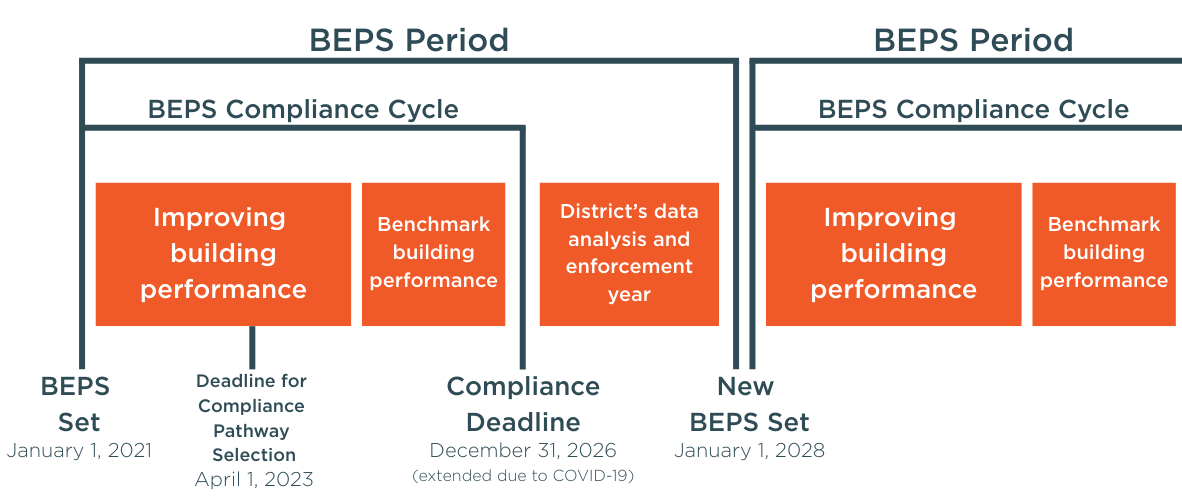
The graphics below illustrate the BEPS compliance timeline for a building with 2021 baseline performance below the BEPS and the steps needed to demonstrate an improvement in energy use to avoid any financial penalties.

Diagram illustrating Washington, DC’s Building Energy Performance Standards (BEPS) compliance timeline across multiple periods. The graphic shows two BEPS periods, each containing a BEPS compliance cycle. In the first BEPS period, BEPS is set on January 1, 2021, followed by benchmarking building performance and a five‑year phase focused on improving building performance. A deadline for compliance pathway selection is shown as April 1, 2023. The compliance deadline is December 31, 2026, noted as extended due to COVID‑19, followed by the District’s data analysis and enforcement year. The timeline then transitions to a new BEPS period beginning January 1, 2028, with a new compliance cycle that again includes benchmarking and improving building performance.

Five years may sound like a long time, but it goes by quickly once you factor in all the steps necessary to design, install, measure, and verify energy conservation measures in an existing building.

At SWA, we’re working closely with building owners to evaluate their BEPS compliance options and determine the most cost-effective measures for their buildings. Now that BEPS is in full swing, it’s imperative that building owners begin to chart their path and start planning now for future deep energy retrofits and electrification.

Click here to speak with one of our energy efficiency experts.

This blog post was originally published on September 11, 2019. Our team will continue to update this blog post with new guidance.

Contributors: Andrea Foss, Sustainability Director at SWA; Bob Hayes, Senior Building Systems Engineer at SWA