
Blog
Maryland’s Building Energy Performance Standards (BEPS) is in full effect for buildings 35,000 square feet and over. Here’s our quick guide to the state BEPS and our recommendations for Maryland building owners.

Maryland is implementing a state-wide Building Energy Performance Standards (BEPS) for buildings 35,000 square feet and over as a requirement under the Climate Solutions Now Act of 2022. A number of updates have been made to the law since the regulations went into effect in December 2024. Throughout this blog post, we’ve added what’s new and recent.
Want to go right to our 2026 updates? Use these links:
The proposed BEPS regulations were first published in December 2023 and were followed by an updated draft in July 2024.
Last year, a notice of adoption was published in the Maryland Register; the regulations (COMAR 26.28) are in effective as of December 23, 2024. This entails two regulations for buildings: energy benchmarking beginning in 2025 and direct greenhouse gas (GHG) emissions standards beginning in 2030.
The goal of Maryland BEPS is to document and analyze building energy usage through benchmarking, reach zero net direct GHG emissions by 2040, and improve energy efficiency for Maryland’s buildings.
Any existing commercial, multifamily, or state of Maryland owned building over 35,000 SF, excluding the parking garage area, is defined as a “covered building” under BEPS. There are a few exceptions including historic properties, elementary or secondary schools, manufacturing, agricultural, federal government buildings, and demolished buildings. The regulations also outline eligibility, reporting, and performance standards for campuses in section 26.28.04.03.
The Maryland Department of Environment (MDE) hosts a BEPS portal for covered buildings with “unique building identifiers” (UBIDs) where owners can search for their buildings by address.
Any newly constructed building put into operation after 2024 that is over 35,000 SF will be required to begin benchmarking and reporting after the first full calendar year of occupancy.
In addition, newly constructed covered buildings with a full year of occupancy are also required to comply with the performance standards set in BEPS regulations.
Benchmarking is the process of measuring, reporting, and assessing a building’s energy usage data. The regulations have established benchmarking and reporting requirements for building owners, tenants, electric and gas companies, and district energy providers. Technical Manual TM 24-01 [PDF] includes a list of spaces for which energy use should be excluded during benchmarking.
The first year of statewide benchmarking is complete as of the September 2025 deadline. Maryland Department of Environment (MDE) mailed the Notices of Required Action to buildings that have not completed benchmarking or submitted exemption requests. The BEPS portal is also periodically updated with buildings’ current status.
MDE suggests that building owners contact the Department via email at BEPS.MDE@maryland.gov and illustrate their current efforts to come into compliance.
Action item: Plan to get started right away if your building is covered under BEPS and you have not yet completed benchmarking for 2025.
Third-party verification of benchmarking data is also required at certain intervals. This means that an independent, qualified individual must review and confirm the accuracy of the building’s benchmarking and energy usage data to ensure quality.
The technical manual also establishes approved qualifications of third-party verifiers for benchmarking. MDE approved additional credentials in January 2026; the complete list can be found in the updated Benchmarking Guide v2.0 [PDF]. A third-party verifier can provide both benchmarking and verification services if they have the approved credentials, but they cannot be employees/staff of the building owner.
Get ready for your third-party data verification now! The next benchmarking report is due June 1, 2026, and the major requirement for this year’s reporting is to get the calendar year 2025 data third party verified.
Third-party verification allows your benchmarking data to be checked by a qualified professional to correct any inaccuracies and ensure data quality. Having accurate benchmarking data can also inform you of the appropriate next steps to meet the performance standards.
Action item: Take a look at the sample third party verification request for proposal to hire a verifier and navigate the data verification compliance. (Don’t have a verifier? Contact SWA here.)
Maryland BEPS requires covered buildings to meet annual performance standards based on their respective property type starting in 2030.
The December 2023 draft regulations included both net direct emission and site energy use intensity (EUI) standards [PDF]. The July 2024 updated draft, however, was published with only net direct emissions standards. That year, the legislature postponed the inclusion of site EUI standards [PDF] because they were based on voluntary, unverified energy benchmarking data and due to the impact on projected statewide cost of compliance. Additional work and engagement resulted in regulations being limited to direct emissions only.
It is important to note that the current standards only apply to emissions associated with onsite fuel combustion, such as natural gas and fuel oil. Emissions associated with electricity consumption are not covered under these regulations, meaning that reductions in electricity usage do not assist buildings in meeting their respective targets.
MDE intends to reestablish site EUI standards in 2027 based on 2025 baseline energy data submitted via the benchmarking process. There will be only 3 years between the release of those targets and the first interim compliance year in 2030. Even though these standards are not yet complete, buildings should continue to implement energy efficiency measures to reduce site energy use of buildings, including fossil fuel and electricity savings measures.
Some other notable changes to Maryland BEPS are now in effect under House Bill 49 (HB49):
Fees: Building owners will pay an annual reporting fee of $100, adjusted for inflation, for each building that is covered under the BEPS requirements.
Montgomery County Buildings Waived: Buildings in Montgomery County are waived from the Maryland BEPS (benchmarking and performance standards) requirements since these buildings are covered under the Montgomery County BEPS program.
Exemptions for Hospitals and SCIFs:
New Exclusions and Credits Coming in 2030: The following will be added to the standards from 2030 and beyond.
Covered buildings’ reported emissions data will be evaluated each year for compliance with the net direct emission standards. The owner is subject to an “alternative compliance fee” for every excess metric ton of emissions for compliance if a building exceeds its limit. The compliance fee will be $230 per metric ton of excess CO2e in 2020 dollars, adjusted for inflation for 2030, and it will increase by $4 per metric ton each following year.
There are a few exemptions from benchmarking and BEPS requirements that owners may apply for in a calendar year:
MDE may also determine to allow baseline performance exemptions for reduced occupancy during the baseline year and lower the alternative compliance fees for affordable housing providers. See the updates above for other recent exemptions from HB49.
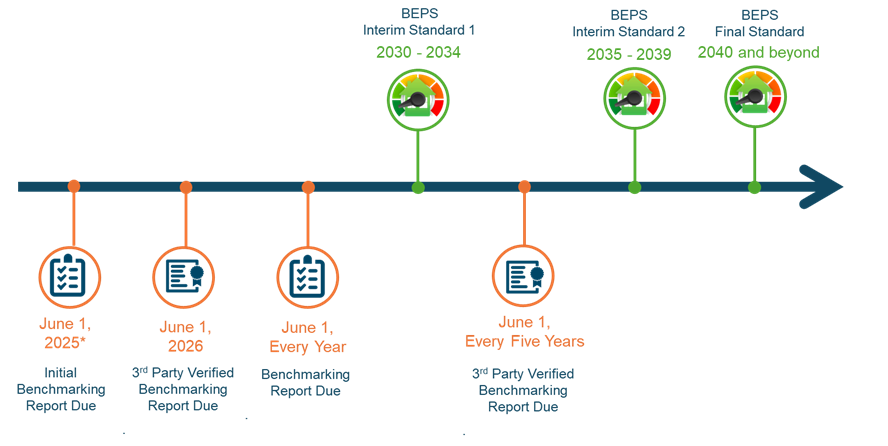
Building owners must submit an initial benchmarking report for calendar year 2024 data by June 1, 2025. However, MDE will accept benchmarking reports up to September 1, 2025, during this first year to assist building owners in the transition to these new requirements, per January 15, 2025 compliance advisory [PDF].
Data for the 2025 calendar year must be submitted by June 1, 2026. In addition to reporting, this data must be third-party verified every 5 years beginning on June 1, 2026. The first required benchmarking report for newly constructed covered buildings must be third-party verified, regardless of calendar year. These buildings must then follow the standard timeline requirements in subsequent years.
The first interim standard year for BEPS starts in 2030. There are increasingly robust interim standards in the 2030-2034 and 2035-2039 periods, and the final performance standard will be enacted for 2040 and beyond.

*MDE intends to treat all initial benchmarking reports submitted by September 1, 2025, as timely.
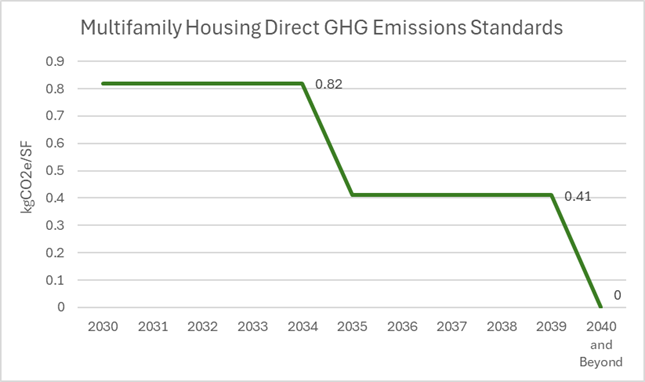
For example, the net direct GHG emissions standards for the BEPS interim period 2030-2034 is 0.82 kgCO2e/SF for multifamily housing. This means all multifamily buildings with weather-normalized net direct GHG emissions above the 0.82 kgCO2e/SF threshold will be subject to the alternative compliance fee during period 1 on a yearly basis. The net direct emissions target for the BEPS interim period 2035-2039 is 0.41 kgCO2e/SF and is 0 from year 2040 and beyond for multifamily housing.

MDE has published resources and hosted information sessions on compliance for benchmarking and BEPS.
More information is available on the MDE BEPS website. You can sign up for the BEPS email list and working group sessions here.
MDE has published new resources for owners and stakeholders for easy navigation of BEPS-related requirements:
Building owners are responsible for benchmarking, reporting, and making the necessary improvements to their buildings to comply with BEPS. Therefore, it is time to plan accordingly and act now.
As Maryland BEPS hits its first interim cycle in 2030, it is time to start communicating with your utility providers and building engineers, planning for building improvements, and considering electrical infrastructure upgrades for BEPS compliance.
Each building may need a different action plan to comply with the BEPS regulations in Maryland. We can support building owners with upcoming benchmarking and third-party verification requirements. In addition, we offer energy auditing and commissioning services for new and existing construction.
We’re ready to help Maryland building owners comply with benchmarking and BEPS. Contact us!
Contributors: Iffat Ridwana, Building Systems Engineer; Adam Szlachetka, Senior Building Systems Consultant
Steven Winter Associates