
Blog
And we have some thoughts. Every topic is on the table: upfront costs, regulatory compliance, commissioning, carbon, accountability, and more.

For more than two decades, LEED—Leadership in Energy and Environmental Design—has helped define what it means for a building to be “green.”
It began when our founder and chairman Steven Winter helped launch the program in 1999 when he was chair of U.S. Green Building Council (USGBC). Since then, the rating system has guided project teams in reducing buildings’ impact on the environment by improving energy performance, producing healthier indoor environments, and changing how the industry makes more responsible material choices.
Many communities across North America are responding to the threat of climate change by developing building performance standards and emissions caps—shifting sustainable building design and operation from voluntary to obligatory.
Building owners and design teams across the country and continent are required not just to design more efficiently, but to demonstrate real reductions in carbon emissions, improved outcomes for occupants, and resilience over time.

LEED v5 arrives at a pivotal moment for the building industry.
Rather than layer on more prescriptive requirements, the LEED v5 program reframes green building tactics around impact. It places much greater emphasis on aspects like early decision-making, measurable performance, and accountability across a building’s full lifespan.
The timeline for LEED v5 adoption just shifted, but at SWA, we’re still advising our project teams to consider moving directly to LEED v5. Its stronger alignment with climate action, policy trends, and long-term building performance goals makes it the more relevant framework moving forward.
If you’re planning a project, now is the time to evaluate your strategy. The extra time might feel like breathing room, but it’s not a reason to slow down. The climate can’t wait any longer.
To get you ready, we’re sharing our LEED v5 “hot takes.”
Yes, we’re being a little snarky, but these are our real perspectives on where the industry is headed.
Just like prior versions, LEED v5 organizes credits into technical categories. While useful, this structure silos credits, encouraging teams to pursue points in isolation, and sometimes at the expense of broader project outcomes.
However, LEED v5 aims to change that thinking by re prioritizing through the introduction of a framework built around three impact areas:
That shift fundamentally changes how teams should approach decision-making with building designs. Instead of asking which credits are easiest to achieve, teams should now see the synergies between credits and ask which strategies meaningfully reduce emissions, improve occupant experience, and protect ecosystems. This restructuring helps teams see the big picture and focus on the highest impact items for their project.
More importantly, it changes how LEED fits into the project lifecycle. This is no longer about earning points at discrete moments in design and construction. It’s about delivering measurable performance over time. LEED v5 holds teams accountable not just for what they design, but for how buildings actually perform—bridging the gap between sustainability intent and real-world outcomes.
For owners in particular, this is a meaningful shift. The conversation moves away from certification levels and toward long-term value: reduced risk, improved performance, and assets that can hold up under increasing regulatory and market pressure.
Perhaps the most consequential change in LEED v5 is the elevation of early design studies from a best practice to a requirement. Frankly, this is one of the most exciting updates in the entire system.
Projects pursuing LEED v5 must complete early assessments that establish baselines and inform decisions around:
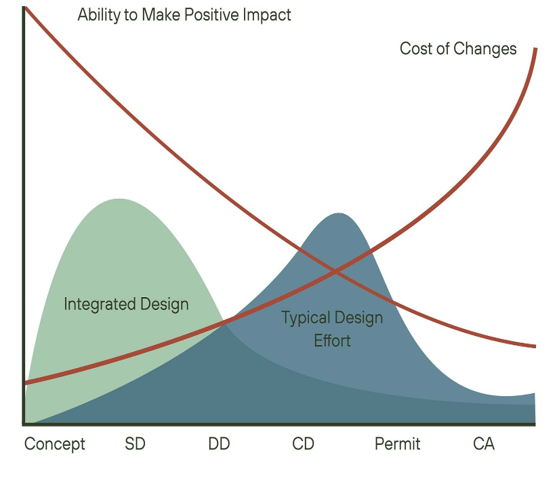
This reflects the reality that the most important decisions happen early. Once massing, building systems, and materials are locked in, the ability to meaningfully influence performance drops sharply, while the cost of making changes rises just as quickly.
Historically, energy modeling and similar analyses would often happen too late in design to drive real design decisions. LEED v5 pushes that work upstream and aligns closely with frameworks like ASHRAE 209, where early stage “simple box” models are used to test design concepts, compare alternative options, and guide direction before details are fully defined.
At this stage, precision isn’t the goal; direction is. Teams use simplified assumptions to evaluate options, identify high-impact strategies, and narrow the path forward while flexibility is still high.
This isn’t just about sustainability; it’s also about cost.
There’s a common misconception that early analysis adds cost. In reality, it’s a relatively small upfront investment that helps avoid much larger downstream costs. LEED v5 makes that tradeoff explicit—and makes early alignment a necessity, not an option.
Early studies deliver direct value to owners and developers. For example, embodied carbon analysis may recommend using less carbon-intensive materials or using materials more efficiently. That often means reducing material quantities altogether, which directly lowers upfront costs. It also reduces the likelihood of one of the biggest sources of budget overruns: late-stage redesigns.

LEED v5 reinforces something that should not be controversial (but somehow still is): design intent does not guarantee performance.
The updated framework expands the role of commissioning (Cx) and shifts more of that work earlier in the process into key design decision points.
Key updates include:
But some of the biggest changes are in how teams are expected to collaborate.
LEED v5 requires commissioning agents to be more formally integrated into the design process. This includes attending targeted design-phase meetings—at least one focused on mechanical, electrical, and plumbing systems, as well as the building envelope—to review comments and align on the commissioning approach. Commissioning agents are also expected to participate in milestone design meetings at 50% and 100% completion.
For Enhanced Cx projects, LEED v5 requires additional design-phase engagement to ensure that commissioning is not just reactive, but actively shaping decisions as the design evolves.
Requiring submittal review as part of Fundamental Cx is also a big deal.
Previously, that level of involvement was limited to Enhanced Cx, which is optional. Since Fundamental Cx is a prerequisite, this change brings the expertise of the commissioning team into the equipment selection process on all projects, not just those that pursue Enhance Cx. This creates more opportunities to catch issues before they become expensive problems.
Lastly, LEED v5 makes a notable shift in the value of MBCx. In past versions, MBCx offered limited additional points and was often overlooked despite its long-term benefits. Now, with adjusted point weighting, there’s more incentive to pursue it.
Many building performance issues don’t show up until after project turnover. MBCx provides the tools to track, verify, and maintain performance over time, bringing LEED closer to its goal of real operational accountability.
Another defining feature of LEED v5 is its shift toward carbon as the primary performance metric, because energy cost savings doesn’t always reflect real climate impact.
For the first time, LEED fully integrates what you might call the whole-carbon story. That includes:
New prerequisites now require teams to:
Together, these analyses create a 25-year projection of building emissions, capturing impacts from operations, materials, and refrigerants.
There are also new and expanded credits, including:
What’s important here is not just the individual requirements, but how they connect. Early design studies now feed directly into carbon projections, which in turn shape design decisions and long-term performance strategies.
This reinforces a core idea in LEED v5: carbon is not something you calculate at the end; it’s something you plan for from the beginning.
While LEED v5 brings needed clarity, it doesn’t make things simpler. It reflects the reality we now live in. And all the while, project teams still need to navigate competing priorities around cost, schedule, constructability, and regulatory compliance.
Carbon-based metrics don’t always translate easily into the financial language that drives most project decisions. Owners are still focused on capital cost, operating cost, and risk, so project teams need to connect carbon outcomes to those priorities in a clear, actionable way.
That might mean framing decisions in terms of:
At the same time, market conditions aren’t making things easier. Construction costs remain volatile. Supply chains continue to fluctuate. Incentive programs are evolving.
But this is exactly why LEED v5 pushes teams to act earlier. Project teams that address these requirements early when design decisions are still flexible will be able to navigate tradeoffs, control costs, and align with long-term climate goals. Teams that wait will find themselves reacting instead of planning, often at a higher cost and with fewer options.
We added a little snark to this post to keep things interesting, but the underlying message is serious.
LEED v5 rewards a specific way of working:
Project teams that treat sustainability as an add-on rather than integrative approaches will find fewer easy wins. Teams that invest in early analysis, cross-disciplinary collaboration, and performance verification will be better positioned to succeed.
At its core, LEED v5 is about accountability. Not just for design decisions, but for long-term outcomes. And for an industry that is increasingly being asked to prove its impact, that shift is long overdue.
Contributors: Andrea Foss, Kai Starn, Nithya Lavu, Rachel Harrington, Sarah Nugent, Sean Fish
More LEED v5 Resources:
Steven Winter Associates